Papariandental@gmail.com
Papariandental@gmail.com

Advances in dental materials and laboratory techniques have made modern dentures far more comfortable and natural in appearance than earlier generations. While dental implants and fixed bridgework remain excellent long-term options for many patients, removable dentures continue to be a practical, adaptable solution for restoring a complete, functional smile.
At the office of Paparian Dental Associates, we work with high-quality acrylics and precision-milled components to create dentures that blend aesthetics with reliable function. Each prosthesis is planned to support facial contours, restore chewing efficiency, and help patients speak and smile with confidence.
Our approach focuses on individualized care: we evaluate the overall mouth, discuss your daily needs and habits, and design a denture that fits your lifestyle. Whether you need a partial that preserves remaining teeth or a full set to replace an entire arch, our goal is a predictable, comfortable result that looks natural.
Losing teeth is rarely a purely cosmetic problem. The absence of one or more teeth alters how the jaw functions and how forces are distributed during chewing. Over time, those shifts can lead to additional wear, migration of neighboring teeth, and uneven pressure that affects the joints and muscles involved in biting and chewing.
There are also social and emotional consequences to tooth loss. People commonly report increased self-consciousness, reluctance to smile in photos or social settings, and changes to how they choose foods — often avoiding nutritious options that are harder to chew. Restoring the missing teeth can improve confidence, nutrition, and overall quality of life.
From a biological standpoint, the jawbone and soft tissues depend on stimulation from teeth to retain shape and volume. When teeth are lost, the underlying bone remodels and can shrink over time, which affects facial support and the way restorations fit. For these reasons, timely replacement — and careful planning for long-term tissue changes — are important considerations in denture care.

Removable dentures are prosthetic appliances that rest on the gums and underlying jawbone, carrying artificial teeth set into a supportive base. The base is shaped to fit the mouth closely, using suction, soft tissue contact, or attachments to stable teeth or implants to stay in position while you speak and eat.
Partial dentures fill gaps where some natural teeth remain and typically use clasps, precision attachments, or a discreet framework to blend into the existing dentition. Complete dentures replace all teeth in an arch and rely on careful adaptation to the contours of the mouth to provide retention, support, and comfort.
One of the practical advantages of removable prosthetics is maintenance: they can be taken out for thorough cleaning, which helps preserve oral hygiene and the health of any remaining teeth and soft tissues. That flexibility also makes adjustments and repairs straightforward when changes in fit occur.
Determining which type of denture best suits you depends on how many natural teeth remain, the health of those teeth, and the condition of the supporting bone and gums. A thoughtful clinical exam and diagnostic imaging allow us to recommend options that balance stability, aesthetics, and long-term oral health.
When most or all teeth in an arch are missing or require extraction, a full denture may be the most appropriate solution. When several healthy teeth remain, a removable partial can restore form and function while preventing unwanted drifting of adjacent teeth. In some cases, combining dentures with implants creates a hybrid approach that improves retention and chewing performance.
We prioritize solutions that meet each patient’s functional needs and personal preferences. That can mean a focus on the lightest, most discreet partial for someone with strong remaining teeth, or a tailored full denture for a patient who values a natural look and simple maintenance.
Complete (full) dentures are fabricated to replace all teeth in the upper arch, lower arch, or both. Their design depends on the shape of the jaws, the health of the mouth, and the patient’s expectations for function and appearance.
Conventional full dentures are made after extractions and once the tissues have healed, which can provide a more accurate long-term fit. Immediate dentures are placed at the time of extraction so the patient has teeth during healing; they offer immediate aesthetics but often require relines or adjustments as the mouth remodels.
Immediate (temporary) denture
An immediate denture is delivered at the time teeth are removed so there is no period without teeth. Because soft tissues change during healing, follow-up relines and occasional adjustments are commonly needed to optimize fit and comfort.
Overdentures
Overdentures fit over retained tooth roots or specially placed attachments and can preserve bone and provide improved stability compared with traditional tissue-supported dentures. They strike a balance between support and removability.
Implant-supported dentures
Implant-supported options attach to small titanium posts embedded in the jaw and offer notably greater retention and chewing ability. They can be designed to be removable by the patient or fixed in place, depending on the chosen system and clinical goals.
Partial dentures replace one or several teeth when the remaining natural teeth are stable enough to support an appliance. They restore oral function and play an important role in stopping neighboring teeth from shifting into empty spaces.
Modern partials are constructed from a variety of materials — from lightweight flexible resins to cast metal frameworks — allowing for discreet, comfortable designs that prioritize speech, chewing, and a natural appearance.
Regardless of the chosen design, precision in measurement, tooth selection, and occlusal harmony helps ensure the appliance is easy to wear and maintain over time.
At our practice, we take a careful, case-by-case approach to denture selection and design so the result meets both functional needs and cosmetic expectations.
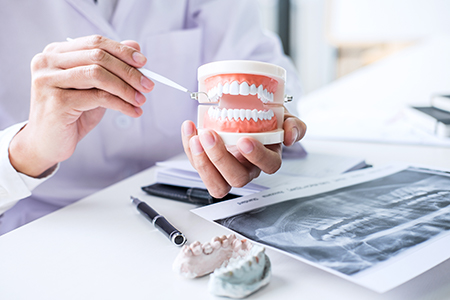
Creating a successful denture begins with a thorough evaluation. We review your medical and dental history, take precise impressions and measurements, and often use diagnostic imaging to assess bone levels and tooth support. This information guides decisions about extractions, implant placement (if appropriate), and pre-prosthetic tissue shaping.
Sometimes minor preparatory procedures — smoothing rough edges, grafting small defect areas, or adjusting soft tissue contours — make a significant difference in how a denture fits and functions. We discuss these options openly and recommend the steps that best protect oral health and long-term comfort.
The lab process is equally important. Tooth selection, shade matching, and the arrangement of teeth influence both the appearance and the mechanics of the denture. We work closely with experienced dental technicians to produce restorations that are durable, lifelike, and well balanced for chewing.
After insertion, we schedule follow-up visits to fine-tune fit, address pressure points, and ensure the appliance integrates smoothly with daily activities like speaking and eating.

Adjusting to a denture is a gradual process for most people. Initial changes may include increased saliva, mild discomfort at pressure points, or a temporary difference in speech. These are expected as the mouth learns to accommodate the new appliance, and most issues resolve with a few simple adjustments and practice.
Practical strategies — such as reading aloud to improve speech, beginning with soft foods, and chewing evenly on both sides — help speed adaptation. We provide step-by-step guidance so patients feel confident using their new teeth at home.
Cleaning and routine care are essential to long-term success. Dentures should be rinsed after meals, brushed with a non-abrasive cleaner, and stored in water or a denture soak when not in use. Regular dental checkups let us examine both the prosthesis and the health of the underlying tissues or remaining teeth.
Over many months and years, the mouth changes. Follow-up visits allow us to reline, adjust, or repair appliances so they continue to fit comfortably. Where additional stability is needed, options such as implant attachments or improved adhesive techniques can be discussed and planned.
Adjusting to a new denture
Initial soreness or the need for minor adjustments is common; wearing the denture and returning for refinements helps us identify and relieve any problem areas.
Changes in saliva
A temporary increase in saliva production is a normal response as your mouth adapts to the new appliance and typically subsides within a short time.
Speaking and pronunciation
Practicing sounds and sentences out loud can speed recovery of clear speech; most patients regain natural speech patterns within days to weeks.
Eating with confidence
Start with softer, cut foods and chew slowly. As you become more accustomed to the denture, you’ll regain the ability to enjoy a wider variety of foods.
Daily cleaning and nightly rest
Rinse dentures after eating and brush them daily with a brush and cleaner designed for denture care.
Clean the gums and any remaining teeth gently with a soft toothbrush to maintain tissue health.
Remove dentures at night to allow the mouth to rest and to reduce the risk of tissue irritation or infection.
Stability and retention options
Depending on tissue support and personal preferences, adhesives or implant attachments can improve comfort and confidence while wearing full dentures.
Routine follow-up
Regular visits allow us to check fit, evaluate oral health, and recommend relines or repairs as the shape of the mouth evolves.
Paparian Dental Associates is committed to clear communication and careful craftsmanship when it comes to denture care. If you’d like to learn more about which denture solution is best for you, or what to expect during the planning and fitting process, please contact us for more information.
Today, it’s easier than ever to replace missing teeth and achieve natural-looking, durable, and long-lasting results! Depending on a patient’s dental needs, lifestyle, expectations of care, and budget, choices can include conventional fixed bridgework, dental implants, or removable partial and complete dentures. At the office of Paparian Dental Associates, we’ll discuss all your options in care and answer all your questions as you choose the solution that’s right for you.
With advances in dental materials and technology, today’s dentures are more comfortable and realistic-looking than ever before.
Whether you wear partial or complete dentures, it’s essential to see the dentist for routine care. Besides checking the fit and condition of your dentures and making any necessary adjustments, you’ll also receive a comprehensive exam to check on the health of any remaining teeth as well as the soft and hard tissues in and around the oral cavity.
A same-day denture offers an accelerated design and fabrication process that allows a patient to go from impression taking to denture insertion in a single day.
For patients who don’t want to wait after having teeth extracted, an immediate denture can be inserted the same day your teeth are removed. Sometime later you may need the denture relined to address any changes in its fit once the extraction sites have completely healed.
While no one wants to drop or break a partial or complete denture, accidents do happen. The good news is that in some cases, your partial or complete denture is reparable. It all depends on the extent of the damage. Don’t hesitate to contact our office if you’ve broken or damaged your denture. We’re happy to help.
The simple act of taking your partial denture in and out can cause certain types of metal clasps to loosen over time. When you come in for your checkup visit or contact our office for an adjustment, we’ll assess the fit of your partial and tighten the clasps for improved stability and comfort.
While rebuilding a complete smile is a worthwhile investment, our office is sensitive to the costs involved in dental care. We customize care and will discuss which treatment options address your needs, lifestyle, and budget. How much a new denture will cost depends on the type of the prosthesis, its design, and the materials used to fabricate the supportive base, teeth, and clasps or precision attachments. Dentures that include the placement of dental implants for added retention and stability typically involve additional costs.
If you have dental insurance, your coverage may include a new or replacement set of dentures. Our staff is happy to review your coverage with you to ensure you are maximizing your insurance benefits while minimizing any out of pocket expenses.
At the office of Paparian Dental Associates, we provide an extensive range of dental services, including the latest and most effective methods to help patients with missing teeth rebuild complete and beautiful smiles. As skilled and experienced professionals, we recognize that every patient is different, and every smile is unique. We’re passionate about what we do and take great pride in providing personalized treatment plans while treating our patients as valued partners in care.
Dentures are removable prosthetic appliances that replace missing teeth and surrounding oral tissues to restore appearance and function. They consist of artificial teeth set into a supportive base that is shaped to fit the gums and underlying bone. Modern materials and precision laboratory techniques make contemporary dentures more comfortable and lifelike than older designs.
When properly fitted, dentures help restore chewing ability, clarify speech, and re-establish facial support that can be lost with tooth loss. They also help prevent adjacent teeth from shifting into empty spaces and can improve nutrition by making a wider variety of foods easier to eat. Regular evaluation and occasional adjustments keep the prosthesis functioning reliably over time.
Candidates for dentures typically include people who have lost several or all teeth in an upper or lower arch or who have teeth that are not salvageable through other restorations. A thorough clinical exam, review of medical history, and diagnostic imaging help determine whether removable prosthetics are the most appropriate option. Factors such as the condition of remaining teeth, bone volume, gum health, and general health are all considered during evaluation.
For some patients, alternatives like bridges or dental implants may also be viable depending on jawbone support and personal goals. In many situations a hybrid approach combining dentures with implants can offer improved stability while preserving ease of care. The best solution balances long-term oral health, functional needs, and the patient's lifestyle preferences.
There are several denture types to address different clinical needs, including full (complete) dentures, removable partial dentures, immediate dentures, overdentures, and implant-supported dentures. Full dentures replace all teeth in an arch and rely on close adaptation to the mouth for retention, while partial dentures fill gaps and often attach to remaining teeth with clasps or precision attachments. Overdentures fit over retained roots or attachments and help preserve bone and tissue contours compared with traditional tissue-supported appliances.
Implant-supported dentures attach to small titanium posts placed in the jaw and offer superior retention and chewing ability; they can be designed to be removable or fixed depending on the chosen system. Immediate dentures are placed at the time of extraction so the patient is never without teeth, but they commonly require relines as tissues heal. Each option has trade-offs in terms of stability, maintenance, and long-term tissue changes, so individualized planning is essential.
Conventional dentures are fabricated after extractions and tissue healing are complete, which generally allows the laboratory to produce a prosthesis that fits the healed contours of the mouth. Because they are made from healed tissues, conventional dentures often require fewer early adjustments and can offer a more predictable long-term fit. The fabrication process typically includes impressions, bite records, wax try-ins, and final processing to match tooth position and shade to the patient.
Immediate dentures, by contrast, are inserted at the time teeth are removed so the patient does not experience a period without teeth. These immediate appliances provide immediate aesthetics and function but frequently need relines, adjustments, or remakes as the underlying tissues remodel during healing. Patients receiving immediate dentures should expect follow-up visits to refine fit and optimize comfort as the mouth changes.
Designing a successful denture begins with a thorough clinical evaluation, including medical and dental history, precise impressions, bite records, and often radiographic imaging to assess bone and tissue. These records guide decisions about tooth selection, occlusion, and whether preparatory procedures such as extractions, smoothing, or minor grafting are needed to support the prosthesis. Clear communication about functional goals and cosmetic expectations helps shape the final plan.
The laboratory phase is a collaborative process between the dentist and skilled dental technicians who select tooth shapes, arrange teeth for balanced function, and process the base using durable materials. Trial appointments allow the patient and clinician to evaluate appearance and bite before finalizing the denture, and careful insertion combined with scheduled follow-ups ensures that pressure points are relieved and function is optimized. The office of Paparian Dental Associates works with experienced technicians and modern materials to produce durable, lifelike restorations.
Daily denture care helps preserve the appliance and protect oral tissues. After meals, rinse dentures to remove food debris, then brush them gently with a soft brush and a nonabrasive denture cleaner to remove plaque and stains. Avoid using regular toothpaste or abrasive household cleaners, and never soak dentures in hot or boiling water which can warp the base.
At night remove dentures to allow the gums to rest and to reduce the risk of irritation or infection, storing them in plain water or a recommended denture soak. It is also important to clean and gently brush the gums, tongue, and any natural teeth to maintain tissue health. Regular dental checkups let your clinician examine the fit, assess oral health, and advise on relines, repairs, or alternative solutions if changes occur.
The useful lifespan of a denture varies by material, how well it is cared for, and changes in the wearer’s mouth, but many prostheses provide service for several years with proper maintenance. Over time the jawbone and soft tissues remodel, which can cause a previously well-fitting denture to loosen, create pressure points, or affect chewing efficiency. Routine follow-up appointments allow the dental team to monitor these changes and recommend relines or repairs when necessary.
Relines restore close contact between the denture base and the supporting tissues and are a common, straightforward way to extend the appliance’s comfortable function. Repairs are available for fractured bases or broken teeth and should be performed promptly to avoid tissue injury or further damage. If repeated adjustments are needed, alternative options such as implant-retained attachments may be discussed to improve stability and long-term performance.
Implant-supported dentures are anchored to dental implants placed in the jaw, which significantly improves retention, stability, and chewing efficiency compared with tissue-supported appliances. Because implants transmit functional forces to the bone, they can help preserve bone volume and facial support that might otherwise diminish after tooth loss. Implant attachments can be designed so the denture is removable for cleaning or fixed for a more permanent solution depending on clinical goals.
This hybrid approach often allows patients to eat a wider variety of foods with greater confidence and reduces sore spots related to slipping. Implant-supported options require careful planning, adequate bone support, and a coordinated surgical-restorative approach, but they offer a predictable way to enhance comfort and function for many patients. Your clinician can explain candidacy, the surgical timeline, and the maintenance needs for implant-supported prosthetics.
Adapting to new dentures is a gradual process that commonly involves temporary symptoms such as increased saliva, mild soreness at pressure points, and changes in speech. These responses are normal as the oral tissues learn to accept the new appliance, and most patients notice steady improvement with regular wear and brief clinical adjustments. Practical measures—such as reading aloud to practice speech, starting with soft foods, and chewing slowly while alternating sides—can accelerate adaptation and build confidence.
Follow-up visits are important during this phase so the dentist can identify and correct sore spots, refine occlusion, and advise on progressive dietary changes. If persistent problems occur, adjustments, relines, or repairs can be made to improve comfort and function. Long-term success depends on close communication with the dental team and adherence to recommended care routines.
Choosing the right denture solution starts with a comprehensive clinical assessment and an open discussion of your functional goals, daily habits, and cosmetic priorities. The number and condition of remaining teeth, the quality of supporting bone and soft tissue, and your overall health will guide recommendations between partials, full dentures, overdentures, or implant-supported designs. Your dentist will review the pros and cons of each approach and explain how they relate to maintenance, expected adjustments, and long-term oral health.
Shared decision-making helps ensure the chosen treatment aligns with your lifestyle and expectations, and good planning often includes trial steps such as provisional appliances or diagnostic wax-ups. If you would like personalized guidance and a customized treatment plan, Paparian Dental Associates can provide a thorough evaluation and discuss the options that best fit your situation.
Our mission is simple: to deliver great oral health and the beautiful smile you deserve. We value your trust and are committed to exceeding your expectations with every solution we provide.